
Understanding Pain When Biting Down in Chicago, IL
Navigating a busy, vibrant lifestyle in downtown Chicago, IL, means enjoying everything from quick business lunches in the Loop to world-class dining along the Magnificent Mile. However, when biting down on a sandwich or chewing your morning meal triggers a sharp, electric shock of pain in a specific tooth, your daily routine can quickly become agonizing. At Water Tower Dental Care, located in the Water Tower Place building, Dr. Daniel Aneszko, Dr. Rana Stino, and Dr. Jennifer Moran are deeply committed to identifying and treating the precise structural causes of oral discomfort. Dr. Aneszko demonstrates a relentless dedication to clinical excellence by completing over 100 hours of advanced continuing education annually, focusing heavily on complex jaw biomechanics and global humanitarian care. When you visit our dentist’s office near you, our priority is to provide a warm, luxurious environment where you can receive immediate relief and regain your peace of mind.
Experiencing pain specifically when applying biting pressure is a clear biological signal that a tooth is structurally compromised or that the supporting ligaments beneath it are severely inflamed. Unlike a constant, generalized ache, pain when biting down often points to a localized mechanical problem that will not resolve on its own. Ignoring this localized discomfort can allow microscopic damage to expand, eventually leading to severe infections or catastrophic tooth fractures. If you are struggling with sharp pain while chewing and need an evaluation, please protect your smile by calling our Chicago dentists near you at (312) 787-2131.
1. A Microscopic Enamel Fracture or Cracked Tooth
 One of the most frequent clinical reasons for a tooth hurting specifically when you bite down is an undiagnosed, hairline crack in the outer enamel. Microscopic fractures can develop over time from chewing on hard ice, biting unpopped popcorn kernels, or chronic stress from clenching your jaw. When you apply pressure to a cracked tooth while chewing, the opposing sides of the micro-fracture flex slightly, irritating the delicate nerve pulp inside.
When you release the biting pressure, the crack suddenly snaps back together, creating a sharp, sudden zing of pain that is characteristic of cracked tooth syndrome. Because these micro-cracks are often invisible to the naked eye and hard to detect on standard digital scans, expert clinical assessment is required. If left untreated, the crack will continue to expand deeper toward the root every time you chew. To stabilize the compromised enamel and protect the nerve, our doctors can place durable, custom same-day crowns that act as a permanent, protective shield over your tooth.
2. Advanced Dental Decay Beneath the Surface
Bacterial tooth decay is another major cause of localized biting pain. When cavity-causing bacteria erode through the hard outer enamel, they enter the softer, microscopic tubules of the underlying dentin layer. Dentin is directly connected to the living nerve chamber at the center of your tooth. When you chew food, the physical pressure forces food particles and fluid deep into the soft, decayed area, pressing directly against exposed nerve pathways.
This mechanical compression registers in your brain as a dull throb or a sharp sting every time pressure is applied. Furthermore, bacteria trapped inside a cavity excrete harsh acidic toxins that make the tooth highly sensitive to temperature changes and sweet foods. Our doctors utilize high-definition digital imaging and advanced general dentistry techniques to detect hidden decay between teeth or beneath old fillings, allowing us to remove the bacteria and restore your structural strength cleanly. If you suspect an active cavity is causing your chewing discomfort, reach out to our front desk by calling (312) 787-2131.
3. An Aggravated or Infected Dental Nerve Pulp
 If biting down produces a deep, lingering ache that continues to throb long after you stop chewing, the living nerve pulp inside your tooth may be severely inflamed or infected. This condition, known as pulpitis, occurs when advanced decay, physical trauma, or a deep crack allows bacteria to breach the pulp chamber. As your body attempts to fight off the bacterial invasion, blood rushes to the area, causing the delicate internal tissues to swell.
Because the nerve pulp is tightly enclosed inside rigid walls of mineralized enamel, there is no room for the inflamed tissue to expand. Applying biting pressure compresses the swollen, hyper-sensitive nerve further against the hard inner walls of the tooth. If the nerve dies completely, bacteria will push out through the root tip into the surrounding jawbone, forming a painful abscess. Seeking prompt care is essential to eliminate the infection and save your tooth. If you are experiencing severe, throbbing pain when biting, please call us at (312) 787-2131 to schedule an urgent evaluation.
4. High Spots on a Recent Dental Filling or Crown
If you recently had a dental restoration placed and notice that biting down feels uncomfortable or uneven, the issue may simply be that the restoration is slightly too tall. Even a microscopic high spot on a new filling or crown can completely throw off the delicate balance of your bite mechanics.
When your teeth meet together, the high spot receives the entire force of your jaw muscles before any other tooth touches. This unnatural, repetitive impact severely bruises the delicate periodontal ligament that cushions the root inside your jawbone.
This localized ligament trauma leads to distinct physical symptoms:
- A localized, tender ache when chewing or tapping the tooth.
- A feeling that the restored tooth is hitting first or feels “taller” than your surrounding teeth.
- Increased sensitivity to cold air or cold drinks due to ligament inflammation.
Fortunately, adjusting a high spot is a quick, completely painless process. Our doctors can carefully smooth down the restoration to redistribute your chewing forces evenly across your arch. If your recent dental work feels slightly uneven, contact our office at (312) 787-2131 for a simple bite adjustment.
5. Deep Gum Inflammation and Periodontal Pocketing
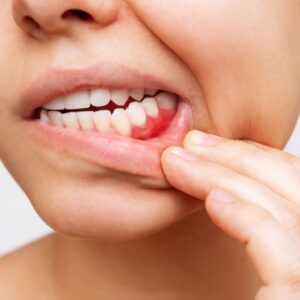 Sometimes, biting pain does not originate inside the tooth itself, but rather in the supporting tissues and jawbone that hold the tooth in place. When plaque and calcified tartar accumulate beneath your gum line, harmful bacteria trigger a chronic infection known as periodontal disease. As the infection progresses, it destroys the attachment fibers and deepens the natural pockets between your teeth and gums.
When you chew food, the physical pressure pushes the tooth down into the inflamed, infected pocket, pressing directly against swollen gum tissue and damaged bone. This creates a deep, sore ache around the base of the tooth. To restore your supporting foundation, our team provides specialized gum disease therapy to eliminate deep bacterial colonies and allow your soft tissues to heal firmly around your teeth.
Reclaim Your Biting Comfort on the Magnificent Mile
You do not have to live with the fear of chewing or let biting pain dictate your daily dining choices. At Water Tower Dental Care, we combine advanced digital diagnostics with an uncompromising standard of patient luxury to ensure your treatment is efficient, precise, and completely stress-free. Dr. Aneszko, Dr. Stino, and Dr. Moran treat every patient exactly like family, providing personalized continuity of care that addresses the true root cause of your discomfort.
When you arrive at our practice inside Water Tower Place, we invite you to completely relax with our exclusive Comfort Menu. Sink into our plush memory foam chairs, sip a freshly prepared real fruit smoothie, and watch your favorite shows on ceiling-mounted TVs with Bose noise-canceling headphones while our experts carefully analyze your bite mechanics. If you are looking for experienced dentists near you who will restore your smile’s strength and comfort in a luxurious setting, your search ends right here on North Michigan Avenue. Please request an appointment with our Chicago dental office online or contact our office directly by calling (312) 787-2131 to take the first step toward a healthy, pain-free smile today.